
New online tool empowers communities to reduce their PFAS exposure
 As communities and scientists uncover just how extensively PFAS, or “forever chemicals,” have contaminated drinking water systems across the country, a growing public health crisis is coming into sharper focus. These synthetic chemicals are widespread, slow to break down, and can linger in the body for years after a person is exposed, sometimes leading to cancer, decreased fertility, and other health problems.
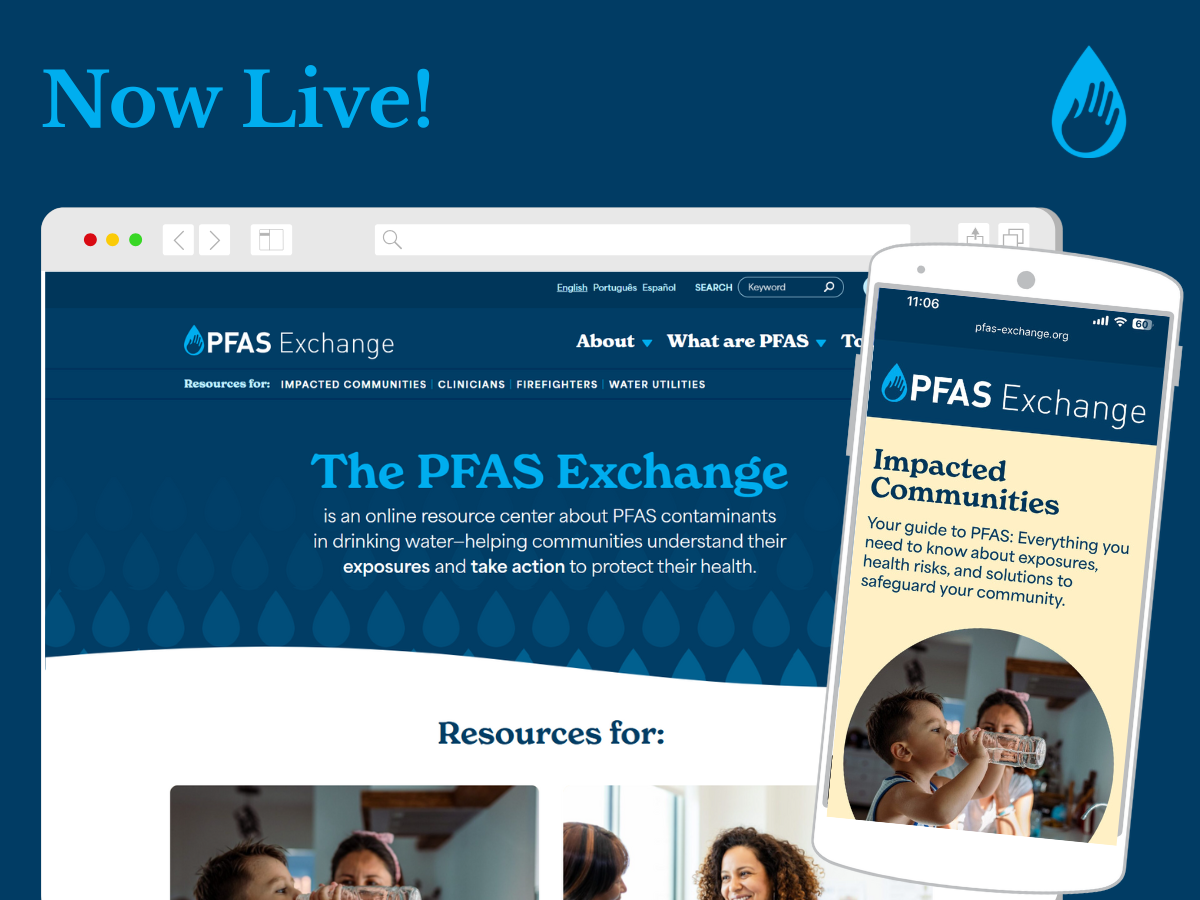
To help people navigate these risks, Silent Spring Institute and its partners created the PFAS Exchange, a free online resource center designed to help people understand their exposure and take action. Recently relaunched with a fresh design and expanded information, the website is a vital resource not only for communities impacted by contamination, but also for clinicians caring for patients with elevated PFAS levels, firefighters who may have been exposed on the job, and water and wastewater utilities looking for guidance on treatment options. The site is also available in Spanish and Portuguese.
The site’s launch comes at a pivotal moment for national policy. In 2024, after years of pressure from community advocates and growing evidence of these chemicals’ toxicity, the Environmental Protection Agency (EPA) set the first federal limits on PFAS in public water systems. “The efforts of everyday people sounding the alarm about PFAS in their community led to significant change,” says Dr. Laurel Schaider, a senior scientist and water quality expert at Silent Spring.
Yet, under the new administration, EPA has announced plans to roll back these protections. In May of this year, the agency announced it intends to regulate only the two most common PFAS. It also plans to delay the deadline for water suppliers to meet the new drinking water standards until 2031.
These changes worry Schaider. “It’s important to put these standards in place sooner rather than later,” she says. “By delaying, we’re missing an opportunity to prevent disease.”
Even as federal action on PFAS stalls, communities can continue to move forward, says Schaider. The PFAS Exchange was built to support that momentum, offering a tool to help people interpret drinking water and blood test results (powered by Silent Spring's DERBI platform), an interactive map of contamination sites and local support groups, and medical guidance for healthcare providers, among other resources.
If you’re wondering about PFAS in your drinking water, here are some things you can do to protect yourself.
1. Start with a little research
Use the PFAS Exchange’s contamination map to see if you live or have lived in an area with a PFAS problem.
Find out if your town or city water has been tested for PFAS. Call your local water utility or state health department, or visit their website to learn if your public water system has elevated PFAS.
If you have a private well, have your water tested. “People are often surprised to learn that, unlike public water systems, private wells are not covered by the Safe Drinking Water Act,” says Schaider. She recommends contacting your health department for information on local water testing services that screen for PFAS, or finding a certified lab through The NELAC Institute (TNI)’s database. You can use the PFAS Exchange’s free exposure tool to help interpret your results.
2. Treat your water
If you’re concerned about PFAS in your drinking water, filtering is a smart choice. This is especially important if you own a private well and testing shows contamination, but it also can be helpful even when your water comes from a public system. And, even if your water doesn’t contain elevated PFAS, filtering your water may still be beneficial. For instance, most public water systems add chlorine to disinfect the water, an important public health measure that prevents disease, Schaider explains. “But chlorine can also break down into byproducts and some of those byproducts can cause cancer. It’s never a bad idea to filter those out.”
There are two main options for filtering water at home: carbon filters and reverse osmosis. Carbon filters are a relatively low-cost option. They can be solid carbon block filters (for under your sink) or granular activated carbon filters (as in a filter pitcher). Reverse osmosis is considered the most effective for a wider range of PFAS chemicals, but it’s also more expensive and generates a lot of wastewater. You can visit the PFAS Exchange to learn more about water treatment options.
3. Talk to your doctor
If you’re concerned about your PFAS exposure, even if your exposure happened in the past, you can discuss medical screenings with your doctor. Your physician may order a PFAS blood test. While these tests often aren’t covered by insurance, they can be added to your medical record and might prompt screenings for related health conditions, like high cholesterol and thyroid disease. There’s also evidence that PFAS can decrease vaccine effectiveness. The National Academies created guidance for clinicians about certain types of health screenings to consider for people with elevated exposures.
4. Reduce your PFAS exposure from other sources
PFAS can enter our bodies from many sources, not just drinking water. “Sometimes I think about each person’s exposure as a pie chart,” says Schaider. “One piece of the pie comes from water, another from food, and another from consumer products.” Avoiding products that are nonstick, water-resistant, or stain-resistant is key, she says. A couple more tips for reducing PFAS exposure: eat more fresh foods and fewer packaged foods. Schaider also recommends cooking with stainless steel, cast iron, glass, or enamel instead of Teflon.
5. Take action to protect your community
If you live in a municipality that isn’t meeting the new PFAS standards yet, “the first step is to ask your water district when they plan to start testing and push for that,” Schaider says. Check with your water supplier and reach out to your state’s department of health or environmental protection to get the scoop.
Advocate for better source-water protections. Support initiatives that preserve open land around water sources and prevent pollution from industries and other activities before it reaches your tap. You can also use the PFAS Exchange’s contamination map to check for PFAS-affected sites in your area and connect with local water-protection advocacy groups to get involved.
Encourage your town, workplace, or local school to adopt procurement policies that prioritize PFAS-free products. “This is a way to magnify your impact,” Schaider says. “You have more purchasing power when you’re an institution or a municipality, and some communities are already doing this.” Telling companies that you’ll take your business elsewhere if they don’t offer PFAS-free products, or even just asking if they have PFAS-free options, can spark large market changes. “Retailers are sensitive to what their customers say,” says Schaider. “And they can move much more quickly than the federal government.”